|
Examina project My examina
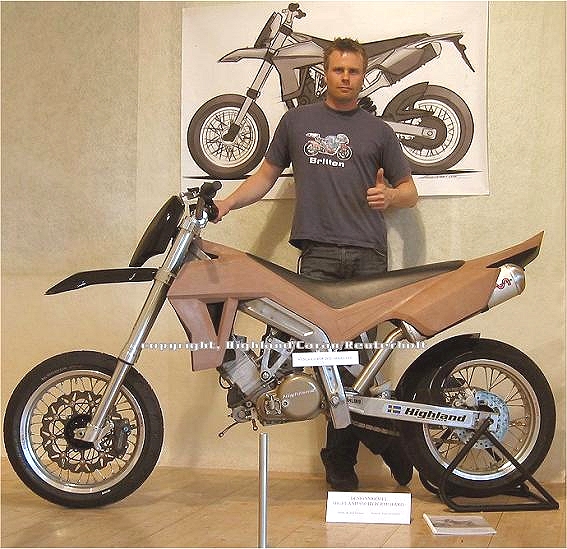
project at the design modeling school Formakademin in Sweden was again
Purpose Goal The images
show different stages and no stage is complete unless stated. The examina
time was 10 weeks, but due to circumstances out of my |
||
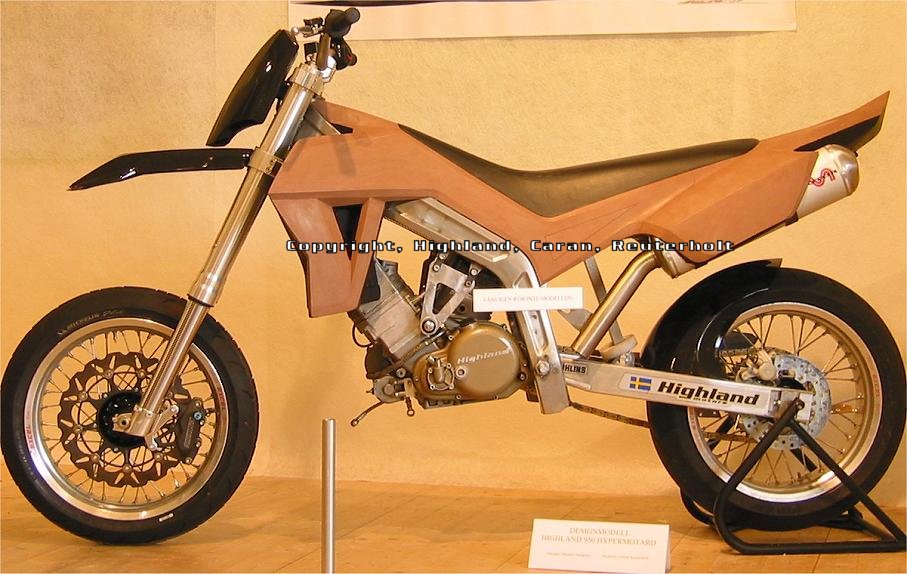
| Construction of support frame When the chassie was delivered it had neither water cooler, subframe, silencers nor drawings for these. Subsequently I had to start with researching the wished for size and position of these.I started to construct a support / subframe in wood and adjustable mounting brackets for the silencers.Then I made wooden water coolers mockups which where positioned with concern to the design sketch and preferable flow of air in mind, the position of the engine demanded one radiator on each side.I calculated the size of the water coolers from facts of the highest capacity watercooler Highland had used for the 950cc engine so far and added a 15% of area as instructed by Highland. The final product will have one silencer and radiator on each side, but during the modeling I choose toonly have one each on the left side. This is how it looked with finished subframe with silencers and radiator mockup. |
||
![]() |
||
| To
be able to get the silencer in the desired position and to give the designer
the possibility to change angle etc I made a mounting bracket with adjustments
in height, angle and length. The supplied silencer clamps would have interfered with the surface, I made new ones in carbon fiber that had a more inwards angle to its bolt flange. |
||
![]() |
||
| I now studied the sketch and
compared the proportions of the frame, saddle etc, and then fabricatedsuitable
styrofoam blocks that were glued on to the wooden subframe. The styrofoam blocks and subframe was then covered with clay in several stages to desired thickness and shape. |
||
![]() |
||
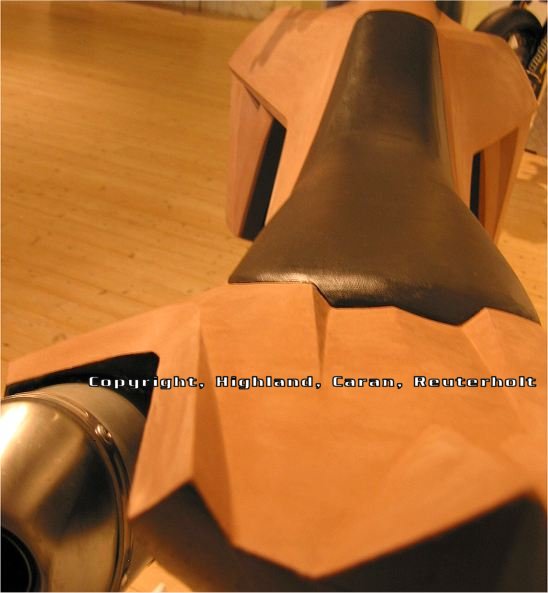
| Sketch modeling Time to start the stimulating and fun sketch modeling work. By definition there is only exterior design on a motorcycle, but I would call it a mix of exterior and interior since the driver is sitting as much in, as on a motorcycle. I did not have a saddle and no measurements for one and the first thing
to do was to find a basic shapefor it, as the rest of the surfaces are
|
||
|
|
||
| During the following day I worked
on getting the surfaces to line up and the designer started to outline the contour with tape. |
||
| Here I have started to work on the radiator wenting hole. | ||
| I paid attention to the radiator
mockups most outward point and made sure it was covered by a minimum of
3-4 mm of clay, a suitable offset to compensate for the thickness of a laminate / plastic. |
||
| I now worked on finding the shape and lower contour of the saddle and contour around the number plate over the silencer. | ||
![]() |
||
| When the contour was set I started to work on the upper surface of the rear fender, which also forms the upper surface of the number plate.I also started to model the wings on both sides of the rear fender. | ||
![]() |
||
| The front fender, headlamp housing and rear swing arm mounted fender/hugger should be identical on the motorcycle i worked on and the other motorcycle that was done at the same time.The work on these details was divided in a way so that I did the clay modeling for the hugger and made moulds for it. And vice versa I had access to the moulds for the front fender and headlamp to make fiberglass laminates.To be able to see the proportions of the parts I did not model in clay, I fabricated simple copies in paperboard that was painted brown. | ||
![]() |
![]() |
|
The hugger had a position close to the tire and because the motorcycle would later be moved it would have been impossible to have clay on the tire without getting cracks. This was solved by making a carbon fiber laminate on top of the tire with a lip that made it possible to bolt it to the underside of the swing arm.I now had a strong and rigid yet thin base to put clay on. |
||
![]() |
![]() |
![]() |
| The holes in the hugger was not made in
the clay modeling, I decided to cut them out in the laminate later on. |
![]() |
|
| Mirroring
After finishing almost all of the sketch modeling I now moved the motorcycle
to a surface plate |
||
![]() |
||
I then moved the motorcycle 180 degrees and started to mark out the measurement points. But first I had to pull the frame 3mm again to compensate and get a correct Y zero again. The 200 measurement points was transferred to the right hand side and marked out with powder chalk. |
||
![]() |
||
| Final modeling After the mirroring was done I had some details left to do that I chose to do on free-hand. One of these things was an air-channel on the topside of the rear fender.The designer marked out the directions with tape and I then modeled from a sketch. |
||
![]() |
||
![]() |
||
| We now made a change to the design of the air
box air-intake. I worked with tapes to find symmetry. |
||
![]() |
||
| Finally getting close to the end and one of
the final details was a split line around the saddle. I worked with tape to get support for the split line tool, a steady hand and clay chip free brushed surface was very important. The saddle was then painted black and given a leather like look with a piece of foam. |
||
![]() |
||
| Mould making
For the moulds of the rear hugger I used Ebalta Polydur. |
||
![]() |
||
| Laminating
The two halves of the hugger mould was treated with wax several times
and finally with release agent. Surface treatment |
||
| Reflections
Caran AB has a broad knowledge in the area of prototype construction
and modeleing. |
||
![]() |
||
|
That was my examina project, It was given the highest degree possible
at my school, Pass with special distinction. Currently seeking employment. Thank you for looking. |
||
|
|
||